FP&A teams have always been measured by the quality of their plans and the strength of their analysis. But now finance leaders face a difficult question: did the business act on the answers they provided while it still mattered?
AI makes this shift harder to ignore. Models, commentary and scenarios can now be produced at machine speed, which changes where FP&A creates value. As Hugh Cumming, CTO at Vena, put it on stage at Excelerate Finance Fest back in May, “When production gets cheaper, judgment gets more valuable.”
That judgment depends on context. Finance needs access to the right data, a clear view across systems and enough knowledge of the business to separate signal from noise and decide what the organization should do next.
Without the guardrails of deep business context, AI only creates more material for leaders to review and extract what is helpful. You may be able to generate additional scenarios, but decisions will still remain stuck, and the gap between insight and action widens.
Paradoxically, AI can increase activity while slowing the organization down. As the volume of possible actions grows, FP&A needs to become the organization’s center of focus and prioritization, helping leaders identify what matters most and move decisively.
This article examines what that shift means for FP&A leaders and how teams can reimagine their workstreams around not just owning plans, but how those plans turn into execution.
What Is Decision Latency? The Key Bottleneck for Businesses
Decision latency is the gap between knowing what to do and doing it. The analysis may be available, yet the decision remains stuck while leaders ask for more context or wait for greater certainty.
And as AI makes it easier to produce large volumes of analysis quickly, the stasis teams find themselves in can worsen. Melissa Howatson, CFO at Vena, described the problem clearly at Excelerate Finance Fest: “More insights doesn’t equate to faster outcomes.”
The delay appears in patterns you’re likely familiar with:
- Someone asks for another cut of the data.
- A new scenario introduces another set of assumptions.
- Teams continue validating the recommendation because ownership remains unclear.
- The decision waits for a scheduled review instead of moving when the signal appears.
According to research from West Monroe, 73% of business leaders estimate their organizations lose up to 5% of annual revenue because decisions and execution move too slowly.
The cost also manifests in missed timing and opportunities:
- A pricing change lands after another month of margin erosion.
- A competitor beats you to the punch on a new offering.
- A hiring decision stalls while a revenue-critical team remains understaffed.
- A demand signal arrives early, but inventory commitments remain unchanged, resulting in either a runout or excess stock.
You may eventually still execute on the right decision, but its impact will be undermined.
Two issues often sit underneath that delay:
- A lack of implicit trust between FP&A and other business units: If stakeholders have questioned the accuracy or consistency of finance data in the past, they are more likely to seek additional validation and alignment before acting on a recommendation.
- Process design: Planning systems often remain siloed across functions, so important signals do not automatically reach the right people. Finance then has to move data, context and approvals manually between teams, adding another opportunity for the decision to stall.
How FP&A’s Ownership Is Changing
The FP&A function is uniquely positioned to reduce decision latency because it sits at the intersection of financial data, business priorities and cross-functional planning. They can see where a potential delay would change financial outcomes.
That gives FP&A responsibility for helping the business cut through noise and act with confidence.
As Melissa puts it, “Finance now creates value when it makes sure that the business can act on what it knows versus simply reporting on it.”
As planning moves closer to execution, your FP&A team’s remit changes in three distinct ways. Each one adds accountability for how decisions are made and move through the business.
1. FP&A Coordinates the Enterprise Around Shared Decisions
Finance business partnering usually involves FP&A coming into one-off functional conversations. An orchestrated approach goes a level beyond this by connecting decisions across functions when one team’s assumptions affect another team’s ability to deliver. FP&A makes those dependencies visible early and clarifies who has authority to act.
Consider a proposed technology investment. The commercial rolling forecast may support the investment, while procurement lead times or cash requirements change the timing. When FP&A acts as the strategic orchestrator to their business, their role is to bring those factors into the same decision process and show how each constraint affects the expected outcome.
Orchestrated planning gives this work a repeatable structure. The plan becomes a shared operating model that links assumptions with the teams responsible for carrying them out.
2. FP&A Supervises AI and Protects Trust in Its Outputs
A critical component in fostering business-wide adoption of AI is knowing you can trust the output. This requires setting the right constraints—the context.
Hugh likens this nuance to a genie liberally interpreting how it will grant a wish:
“A lot of people work with AI as though it’s an engineer,” he said at Excelerate Finance Fest. “You hand it a spec sheet and it produces something you need. But it’s more like a genie that has been around for 30,000 years.
You say: ‘I wish that I was the tallest person in the room.
But the genie doesn’t know anything about me, or where I am, and it decides to fulfill that wish by making everyone in the room shorter. And of course that’s not what I intended.”
Sufficient business context—the drivers behind your forecast, the assumptions inside your plan, the definitions that give your metrics meaning—is what moves AI from a general-purpose tool into a governed planning environment shaped by how your organization operates.
Without it, your team remains in review mode i.e., you keep refining prompts because the system lacks the context for a reliable answer.
And why is FP&A well-equipped to be the steward (in partnership with IT) of how its organization uses AI?
They already own much of the data that would be of use to AI, they have a stake in ensuring the accuracy of those outcomes, and they maintain cross-functional relationships with other business units.
3. FP&A Turns Analysis Into an Owned Course of Action
Explaining why a change happened no longer completes the job. The most mature FP&A teams recommend what should happen next, define the expected financial result and help identify who should own it.
AI can now handle more of the production work that once consumed FP&A’s time, including first-pass analysis, commentary and scenario generation. That gives your team more capacity to apply judgment, make the necessary connections to understand the full business context and shape their recommendation.
You can use that capacity to move insight into action by defining the trigger, the decision owner and the expected financial result. Then stay close enough to the outcome to see what worked and improve the next recommendation.
As Hugh explains, this is where FP&A’s value increasingly sits: in “judgment, context and differentiation.”
What This Shift Means for Your Team’s Day to Day
With technology enabling FP&A to shift from simply owning planning to owning more of the business’s performance, teams spend less time producing recurring outputs (decks, models, commentary) and more time interpreting what they mean for the business. This gives FP&A more capacity for the work that depends on experience, context and judgment.
But this also requires a unique set of skills that your team may need to develop. To successfully step into the role of orchestrating the business’s response to dynamic market conditions, your team will need to strengthen these five capabilities:
- Business understanding: how financial and operational considerations—such as revenue, capacity, pricing and investment decisions—interact across the company. This context helps your team assess whether a decision reflects how your organization actually operates.
- Decision framing: define the choice clearly, identify the assumptions that matter most and explain the financial consequences of each available action. This gives leaders a practical basis for making the decision.
- Constructive challenge: question assumptions without slowing the process through endless review. This requires knowing when further analysis could change the answer and when it will only postpone action.
- AI fluency: establish the data governance that AI needs to produce reliable outputs. This means uniting data sources into a single source of truth, enforcing appropriate permissions and defining clear controls for how AI accesses and uses financial information.
- Communication and influence: translate analysis into language that reflects each leader’s and business unit’s priorities, responsibilities and level of understanding. A technically correct recommendation will still fail when the owner does not understand the urgency or trust the logic behind it.
FP&A analysts need opportunities to join business reviews, present recommendations and examine what happened after leaders acted. That experience builds the contextual reasoning needed to interpret analysis in light of how the organization operates.
Start Taking Ownership of Execution, Not Just Plans
You can expand FP&A’s ownership by finding where decisions lose momentum and redesigning the path from signal to action. Start with one recurring decision where delay creates a clear financial cost.
Audit Where Decisions Stall in Your Own Organization
A decision often stalls because people cannot access the full context, trust the inputs or act within their authority.
For your audit, reflect on recent decisions and trace them from the first signal through to execution. Take note of every request, handoff and approval that added time or created friction.
|
Where the Decision Stalls
|
What It Usually Means
|
How To Unblock It
|
|
Leaders request another cut of the data
|
The original analysis did not isolate the assumption that drives the decision
|
Lead with the material driver and state which additional information could change the recommendation
|
|
Teams use conflicting numbers
|
Data definitions or planning versions differ across systems
|
Assign a governed source for each metric and make the current plan visible to every decision-maker
|
|
Finance cannot see operational context
|
Relevant data remains trapped in another system or function
|
Connect the operational input to the financial model before the issue reaches review
|
|
No one has clear authority to act
|
Decision rights have not kept pace with the planning process
|
Name the owner and define the limits within which they can act without further approval
|
|
The decision waits for a scheduled meeting
|
The planning calendar controls the response even after conditions change
|
Create an escalation path that activates when an agreed threshold is crossed
|
|
Analysis leaves the workflow
|
Teams download data, discuss it elsewhere and manually update the plan later
|
Keep the insight, approval and resulting change inside the same governed process
|
Your audit should show whether the delay comes from missing context, process design or unclear accountability. That distinction will guide you on where to rebuild your system first.
Pick One High-Friction Workflow To Redesign Around Signals
Choose a workflow that happens frequently and affects a material outcome, such as headcount approval or pricing changes. Define the signal that should prompt review, then connect it to a named decision-maker and an approved response.
A headcount workflow might trigger review when capacity falls below an agreed threshold. Finance can present the cost, expected revenue effect and available funding at that moment, allowing leadership to act while the signal still matters.
Set a clear review point after execution. This lets you compare the expected result with the actual outcome and improve the assumptions behind the next recommendation.
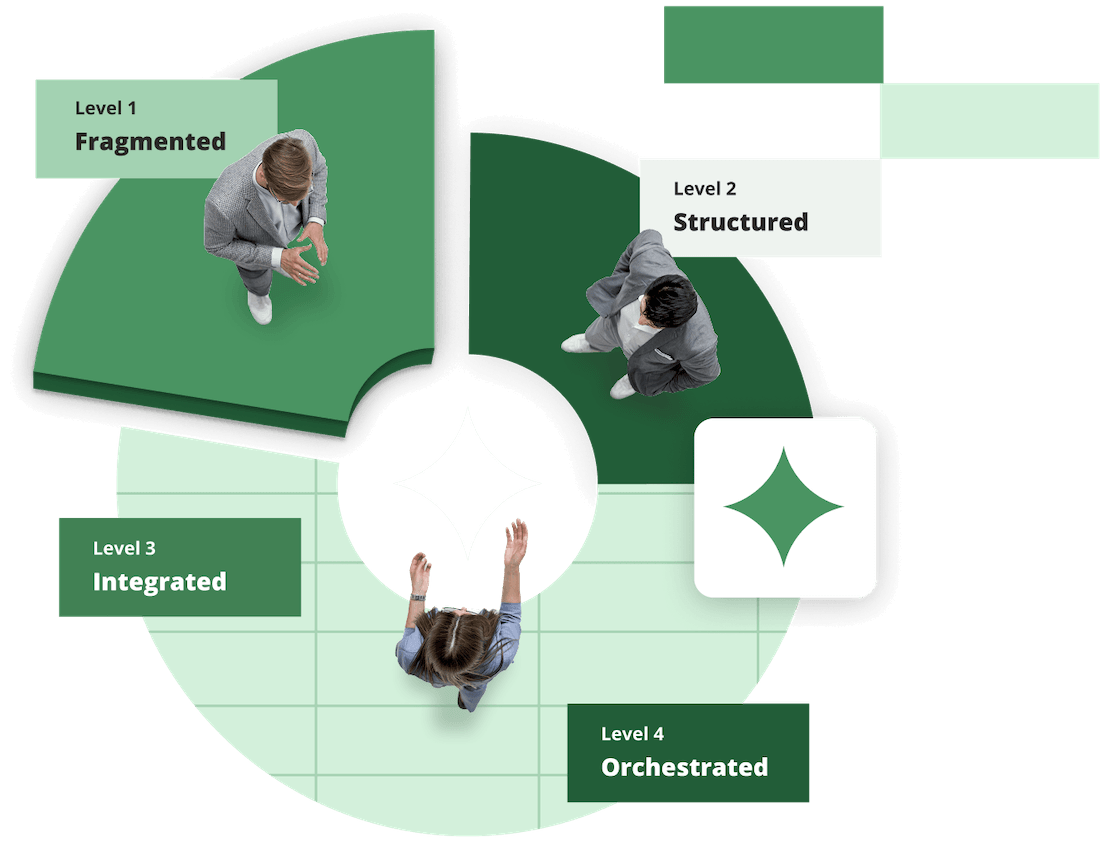
As companies' window of opportunity compresses amid market forces and competitive pressures, the standard for FP&A maturity is changing. Assess where your organization stands today, and discover why the new role of FP&A is that of enterprise orchestrator in Vena’s new report: A New Model of FP&A Maturity for Finance Leaders in the Age of AI.